I am abundant. I am wealthy. Money flows to me easily.
Say one out loud and watch what your mind does with it. Nothing, mostly. There is no room in the sentence, no hour, nothing in your hands. It names a state and leaves out every detail that would let you recognize the state if you were standing in the middle of it.
Money worry is not a feeling
It is a set of small repeatable behaviors, and anyone who has had it can list their own. Opening the banking app before a purchase that was always going to be fine. Reading the right-hand column of a menu before the left. The arithmetic in a queue. The particular flinch at a notification from a bank, before you have even read what it says.
None of that is a mood. It is behavior, with a time and a place attached. Which means its absence is also behavior, with a time and a place attached, and that is the part a mantra never gets to.
The rewrite
Take the sentence and ask a narrower question: what does an ordinary day look like once this is already true?
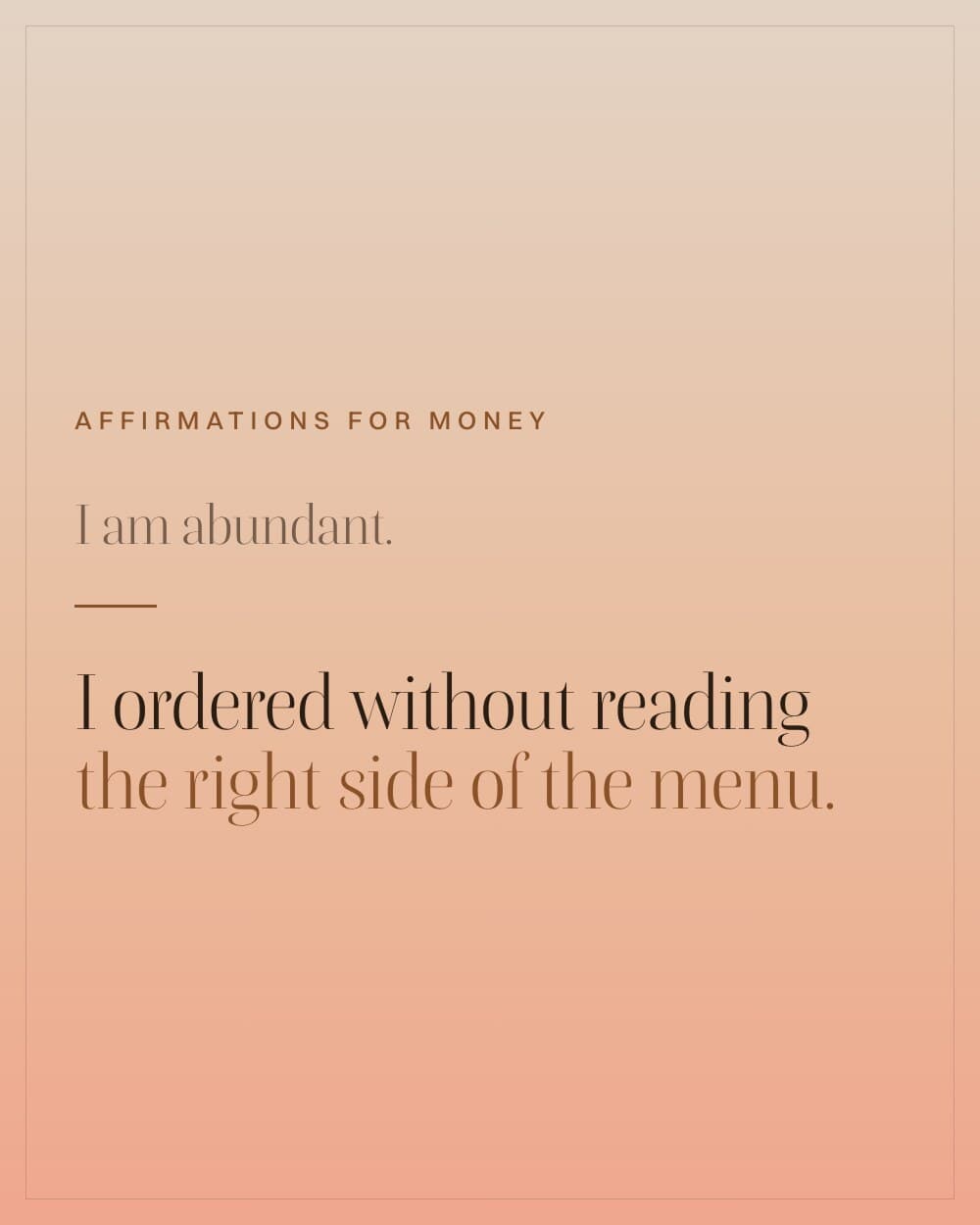
Same claim. But the second has a room in it, an action, and an old habit that did not happen. You could film it. And you would know tonight whether it was true today, which is not something I am abundant will ever tell you.
Why the specific one does anything
Not because the universe is listening. Because your attention is.
A sentence you can picture is a sentence you can return to, and one you return to is one that is still in the room when a decision turns up. That is the whole of it. It is smaller and more ordinary than the word manifestation suggests, and it is the only part that survives contact with a real week.
A general sentence cannot do that work. There is nothing in it to return to, and a claim with nothing in it is also the one your own mind rules against, which is why affirmations start to feel fake.
Writing your own
Four things, and the generic ones miss at least two.
- First person.
- Present tense.
- One goal, not a mood.
- One detail you could photograph.
The last does most of the work. A date, a number you said out loud, a room, a habit that stopped. If you cannot picture the frame, your mind cannot either, and it will file the sentence where it files all vague talk. If you cannot picture anything at all, that is not a disqualification: the picture was only ever there to make the feeling.
Write the moment just after the thing happened, not the thing itself. The moment after is where the detail lives, and it can be far shorter than you think.
The honest part
None of this puts money in an account. Nothing written on a page does, and any page that says otherwise is selling you the pleasant part of a plan and keeping the rest.
What a specific sentence does is keep one goal legible on the days that would rather you forgot it. The earning is still yours. The scene only makes sure you can still describe what you are earning it for.